
The Gender and Development (GAD) Program
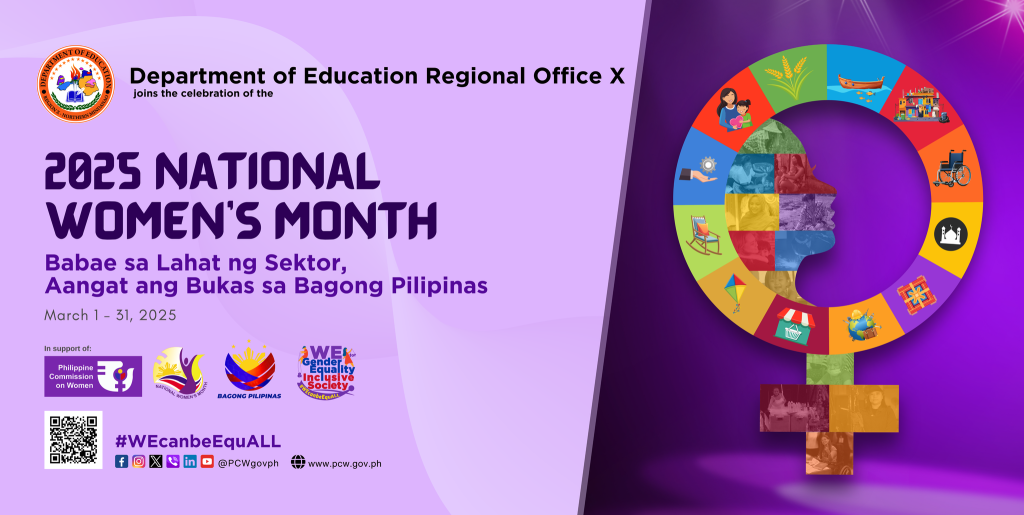
128 years after the country’s independence from colonial rule—which disrupted indigenous systems of equality and institutionalized violence against women—the Philippine Commission on Women (PCW) underscores the urgency of restoring Filipino women’s power and reclaiming pre-colonial values of gender balance. This momentum contributes to the realization of Bagong Pilipinas, the governance brand of President Ferdinand Marcos Jr.’s administration, which calls for transformative change across all sectors of society and government.
Highlighting shared responsibility, collective leadership, and inclusive action, the 2026 National Women’s Month Celebration (NWMC) continues under the 2023–2028 campaign banner, “WE for Gender Equality and Inclusive Society.” It aligns with the Philippine Development Plan 2023–2028, which aims to restore economic momentum, ensure equal opportunities, and equip Filipinos with skills to participate fully in an innovative and globally competitive economy.
2026 National Women’s Month Theme and ASEAN Alignment
More than an annual event, the 2026 NWMC is a clarion call for Women and Everyone (WE) to take part and take charge in advancing gender equality and women’s empowerment (GEWE) at the national and regional levels. It emphasizes a whole-of-government approach and all-of-society engagement.
Under the sub-theme, “Lead like the Babaylans, Filipinas!”, the PCW reaffirms that women’s leadership is a fundamental part of Filipino identity—just as in the time of the revered Babaylans, when women held influence and authority equal to men. It highlights the distinctive leadership qualities of Babaylans—women leaders in pre-colonial Philippines whose authority was grounded in wisdom, empathy, mediation, and moral guidance rather than force or hierarchy.
Babaylans led through inclusion, spiritual insight, and collective care, safeguarding communities and guiding them through conflict. By drawing from these qualities, the celebration underscores how women’s leadership fosters balanced, resilient, and empowered communities—an approach that remains relevant today.
The 2025 Global Gender Gap Report reinforces this, ranking the Philippines 20th out of 148 countries with a parity score of 78.1%, thereby maintaining its position as Asia’s most gender-equal nation.
As the Philippines chairs ASEAN 2026 under the theme “Navigating Our Future, Together,” PCW strategically aligns this year’s NWMC sub-theme as a rallying call for sustained engagement. It also complements the 4th ASEAN Women Leaders Summit, themed “Shaping the Future of ASEAN: Women’s Leadership in Advancing People Empowerment, Regional Security, and Economic Prosperity,” demonstrating how Filipino women continue to advance inclusive governance, peacebuilding, and community development both locally and across the ASEAN region.
By underscoring that women’s full participation is essential to sustainable progress and by amplifying women’s achievements, this year’s celebration champions a Bagong Pilipinas and a resilient ASEAN where equality is practiced, inclusivity is sustained, and every woman’s contribution strengthens communities, institutions, the nation, and the region.
2026 National Women’s Month Objectives
The 2026 NWMC continues to amplify women’s leadership across sectors by reclaiming and embodying the Babaylan model—anchored in wisdom, compassion, courage, and deep responsibility to the community. It affirms gender equality not only as a policy principle but also as a cultural legacy that has long shaped Filipino society.
Through this campaign, women are empowered to lead transformative change in families, communities, Philippine society, and the ASEAN region—demonstrating that gender-responsive leadership drives social progress, regional collaboration, and sustainable development. The celebration reinforces a vital truth: when women lead, communities thrive, societies advance, and nations grow stronger.
Specifically, this year’s celebration aims to:
- Showcase women’s leadership and contributions by demonstrating how Filipino women, are already leading change in governance, peace, security, and economic development in the country and in the ASEAN region by highlighting pathways to embody Babaylan-inspired leadership;
- Promote gender-responsive programs and policies to ensure women have equitable access to opportunities, resources, and meaningful participation in decision-making spaces enabling them to exercise leadership that benefits communities and drives inclusive growth. Empower marginalized and underrepresented women, including rural women, indigenous women, and women with disabilities, by providing capacity-building and meaningful engagements, ensuring all women can participate fully and lead in their communities and sectors.
- Strengthen multi-sectoral collaboration and accountability, engaging national government agencies (NGAs), local government units (LGUs), civil society organizations (CSOs), and other stakeholders to scale up initiatives that achieve visible outcomes for women, supporting leadership that foster transformative change nationally and regionally.

